

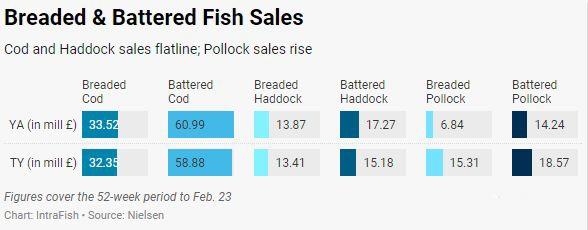
By the end of Feb.23, Pollock Sales Amounted to £127.4 million. Total sales of haddock and COD fell by 5% and 2.3%, respectively.In the future, pollock may occupy the high-end market as the replacement for these products.
According to the latest data from market research firm Nielsen, British consumers are snapping up more pollock products at British retail stores, while no longer use products made from high-quality fish such as cod and haddock.
Data for the 52th week period show that frozen Pollock sales reached 127.4 million pounds (EUR14.178 million/ USD160.44 million) in the same period, up 13.8% from the previous year. Although the average price per kilogram rose by 4.1% to GBP 4.67 (EUR 5.44/USD 7.17), sales quantity still rose by 9.3% to 26,077 tons.

Meanwhile, total sales of frozen Haddock and COD fell by 5% and 2.3%, respectively. Frozen Haddock sales fell 8.1% to 7,646 tons, while the average price per kg rose 3.3% to GBP 7.76 (EUR9.04 / USD11.91). Sales of frozen cod also fell by 6.2% from the previous year to 30,991 tons and the average price per kilogram rose by 4.1% to GBP 6.96 (EUR8.11 / USD9.17).
Jon Stefansson, an analyst at Ocean Data Center, suspects that change is related to increasement of raw material costs for COD and haddock, which have been rising in European markets. Stefansson said: "Pollock is a substitute for these products, which is the main driving force I expect, because the price of Pollock is relatively stable comparedwith COD and haddock.
Pollock accounts for half of the total sales of these 3 products, up to 13,829 tons. While cod sales were 10,094 tons, Haddock sales were only 1,194 tons. Although the low cost of pollock has made it increasingly the main raw material for fishing rods but sales have also soared in higher-end categories, for example, from 30.4% to 123.9% compared with last year. Meanwhile, sales of COD and haddock also declined significantly.

As raw material prices rise, producers are trying to put pressure on retailers and consumers who buy processed products to raise prices, and are trying to push them into retail chains, Stefansson said.
The price of COD may will not decrease
Although prices are expected to be seasonally flat, Stephenson does not expect any significant price falls in the short term. "In the long run, I don't see any significant changes in prices, and I certainly don't think prices will go down, because quotas will not increase except for Russia," he said.
Russia announced it has slight increase in its Alaska cod quota, but this increasement was too small to cause market fluctuation. What may affect prices is the prices of other species. For example, if salmon prices continue to increase like they have in the past few weeks, consumers are more likely to choose whitefish alternatives. That is to say, all market trends in the UK are warning because of the UK's de-Europeanization. The UK market is experiencing a turmoil, and we don't even know what will happen next week.
The Pollock Raw Material Price.
The raw material price of pollock H&G has reached 1550 US dollars per ton at the bonded price of 25 + specifications in Chinese factories, and it will still be 1050 US dollars per ton during the Spring Festival of 2018. It has risen 500 US dollars per ton in one year. Now it looks like this trend is going up.